

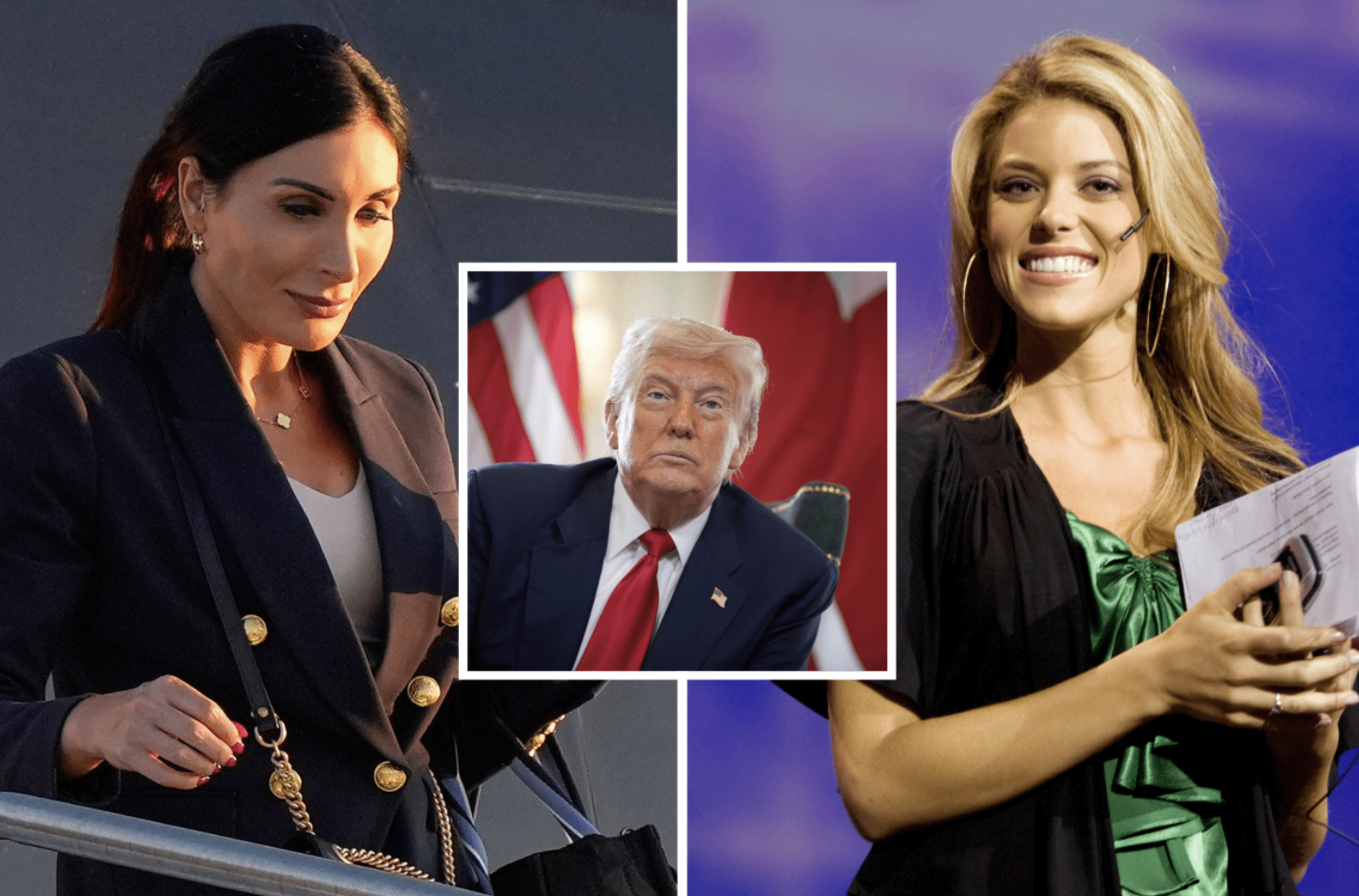
What was billed as a high-profile defense of faith under President Donald Trump has spiraled into public infighting, ideological warfare, and now, an ouster that is raising new questions about loyalty, power, and political boundaries inside the White House.
On Wednesday, Texas Lieutenant Governor Dan Patrick abruptly removed Carrie Prejean Boller from President Trump’s Religious Liberty Commission following a hearing that devolved into shouting, boos, and repeated interruptions over Israel and antisemitism.
The decision came just 48 hours after what insiders described as “one of the most chaotic hearings in the commission’s short history.”
And by Thursday morning, conservative influencer Laura Loomer claimed the White House itself ordered the removal.
“I can confirm the White House directed Dan Patrick to remove Carrie Prejean Boller,” Loomer wrote on X. “He was asked by the White House.”
The White House has not publicly confirmed that claim.
But in Trump’s second term, few observers believe major commission shake-ups happen without West Wing approval.
The Religious Liberty Commission was created in May 2025 during President Trump’s return to office. It was housed inside the Department of Justice and designed to advise the White House Faith Office and the Domestic Policy Council.
The commission’s mandate: investigate threats to religious liberty, examine religious pluralism, and recommend federal policy protections.
Supporters called it a long-overdue defense of Christian Americans.
Critics warned it would blur church-state boundaries and serve as a political vehicle for culture war battles.
Monday’s hearing — the panel’s fifth — focused on what it called “The Religious Liberty Implications of Antisemitism.”
It did not go as planned.
The fireworks began when Boller, a former beauty queen turned conservative activist, addressed Yitzchok Frankel, a UCLA law student who testified about harassment during pro-Palestinian campus protests.
“I take your experience very seriously,” Boller began.
Then she pivoted.
“In a country built on the First Amendment,” she asked, “can someone stand firmly against antisemitism and at the same time condemn the mass killing of Palestinians in Gaza or reject political Zionism?”
The room shifted.
Frankel responded sharply.
“You want to protest Israel, great,” he said. “One hundred percent. Go ahead and do it. But you can’t block Jews. And you can’t assist people in doing that.”
When Boller pressed further — asking whether anti-Zionism is always antisemitism — Frankel answered with a single word.
“Yes.”
Rabbi Ari Berman followed.
“Undoubtedly anti-Zionism is antisemitism,” he said. “You don’t have to support every policy of the Israeli government. But denying Israel’s right to exist? That is antisemitism.”
Boller responded, drawing boos.
“I’m a Catholic,” she said. “Catholics do not embrace Zionism. So are all Catholics antisemitic?”
Patrick cut in immediately.
“This is not a commission on theology,” he said, striking his gavel. “This is not a commission on attacking other faiths.”
But the hearing had already tipped into confrontation.
As the exchanges escalated, Boller clashed with activist Shabbos Kestenbaum and again demanded witnesses condemn Israel’s military campaign in Gaza.
Patrick attempted to regain control.
At one point, he slammed the gavel multiple times.
“You two can have coffee after this and continue the discussion,” he said. “But we are moving on.”
The public tension was palpable.
Democratic lawmakers watching the hearing later described it as “deeply unserious.”
One senior congressional aide told us, “This is what happens when complex geopolitical debates are forced into culture war panels.”
If the first half of the hearing was combustible, the second half exploded.
Seth Dillon, CEO of The Babylon Bee, testified about what he sees as growing antisemitism on the political right.
He specifically referenced conservative commentator Candace Owens.
“Do you believe anything Candace has said is antisemitic?” Dillon asked Boller directly.
“No,” she responded. “I listen to her daily. I haven’t heard one thing out of her mouth that is antisemitic.”
Dillon pushed back.
“The phrase ‘Christ is King’ can be weaponized,” he said. “And she has said worse.”
The exchange grew heated.
The debate spilled into discussions of Tucker Carlson and a controversial Hamptons meeting that occurred before the assassination of conservative activist Charlie Kirk last September — an event that continues to divide Trump-aligned circles.
By the end of the session, multiple attendees described the commission as “completely off the rails.”
Two days later, Patrick announced Boller’s removal.
“No member of the commission has the right to hijack a hearing for their own personal and political agenda,” he wrote on X.
Boller fired back within hours.
“Unless and until I receive written notice from the President of the United States requesting my removal,” she posted in an open letter, “I will continue to defend religious freedom for all religions on this Commission.”
Her argument was simple: Trump appointed her. Only Trump can remove her.
The White House has not publicly addressed that claim.
But insiders say the message was clear.
“The commission was not supposed to become a battlefield over Israel,” one Republican operative said privately. “It became one.”
The implosion comes at a politically delicate time.
President Trump has positioned himself as both a staunch ally of Israel and a defender of Christian voters in his second term. Meanwhile, campus protests over Gaza and U.S. foreign policy continue to roil universities nationwide.
Democrats argue that the commission’s meltdown underscores a broader problem.
“When faith panels become partisan megaphones, they lose credibility,” said one Democratic strategist. “Religious freedom shouldn’t be a proxy war for Middle East politics.”
The administration has yet to announce who, if anyone, will replace Boller.
For now, the Religious Liberty Commission — intended as a showcase of Trump’s commitment to faith — is instead facing headlines about internal division.
And in Washington, perception often matters as much as policy.
One thing is clear: what was designed as a platform for unity has become another flashpoint in America’s already polarized 2026 political climate.
Discover more from Next Gen News
Subscribe to get the latest posts sent to your email.
What we should be doing is preparing to drop all evil religion addiction mental illness out of our lives, USA, and planet!
Haha one big fucking circus which needs a clown in charge a hahaha!!!!