

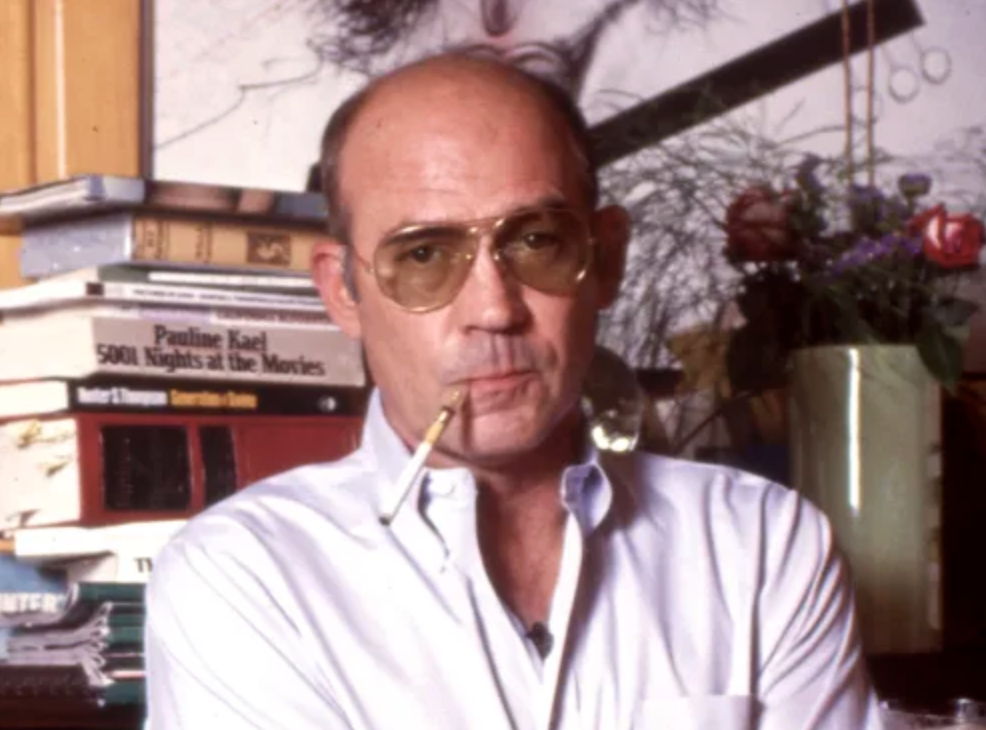
Twenty years after Hunter S. Thompson’s infamous death shocked the literary world, Colorado authorities have quietly reopened the case — and investigators are now looking at what could be one of the most explosive reversals in modern American crime history.
Officials confirmed to reporters that the “gonzo journalist’s suicide” is now being reexamined as a potential homicide, after his widow, Anita Thompson, uncovered what she called a “life-changing discovery.”
Hunter S. Thompson — the wild, whiskey-fueled mind behind Fear and Loathing in Las Vegas and the father of gonzo journalism — was found dead at his Woody Creek, Colorado home in February 2005. The cause was ruled a self-inflicted gunshot wound to the head. He was 67.
At the time, his widow Anita told the Associated Press that her husband had spoken about suicide for months, calling his death “not a surprise, but still unbearable.”
Now, two decades later, the story has taken a stunning turn. Anita, now 53, reportedly made a discovery that she says “changes everything.” According to Pitkin County Sheriff Michael Buglione, “She’d just found out something that is life-changing for her — something she heard from friends and possibly relatives about Hunter’s demise.”
Sheriff Buglione stopped short of confirming foul play but admitted the department is “committed to reexamining every detail to provide closure to the Thompson family.”
Friends close to Thompson’s inner circle told Radar-style sources that suspicions about the writer’s death have lingered for years. One longtime acquaintance said, “Something never sat right about how it all went down. Hunter was reckless, sure, but he wasn’t careless about his legacy. Ending it like that — it didn’t fit.”
Thompson’s son, Juan, was the first to call authorities the night his father died. According to a 2005 police report obtained by the Vail Daily, Deputy John Armstrong arrived at the scene just as three gunshots echoed through the air.
Juan, then 41, emerged from the house holding a shotgun. He told officers the shots were a salute — a ritual “to mark the passing of my father.” Inside, Thompson’s body was found seated at his desk, a .357 revolver at his feet and a .45 handgun nearby.
But Armstrong’s account raised eyebrows even then. “Juan said he heard a dull sound, not a sharp crack typical of a gunshot,” the deputy wrote. “It didn’t sound right.”
Despite that discrepancy, the medical examiner declared the death a suicide, writing, “There’s no smoking gun here.”
Juan later opened up about his complicated relationship with his father in his 2016 memoir, Stories I Tell Myself: Growing Up With Hunter S. Thompson. He described an “explosive, brilliant, and terrifying” household, where “fear and admiration lived in the same room.”
In the book, Juan admitted, “I loved my father, but I also feared him. I think he feared himself, too.”
Now, at 61, Juan has reportedly declined to comment on the reopened investigation, and his son William, 27, told reporters, “We’re not speaking to the press right now. Thank you for understanding.”
The author’s death, like his life, was shrouded in chaos and myth. Friends recall that his ashes were famously blasted from a cannon funded by Johnny Depp, who financed the funeral pyrotechnics that lit up the Colorado sky in 2005.
But for fans and family, the story never truly ended.
As one close friend told reporters this week, “Hunter always said the truth is weirder than fiction — and maybe he was right. Maybe the real story hasn’t been written yet.”
Discover more from Next Gen News
Subscribe to get the latest posts sent to your email.