

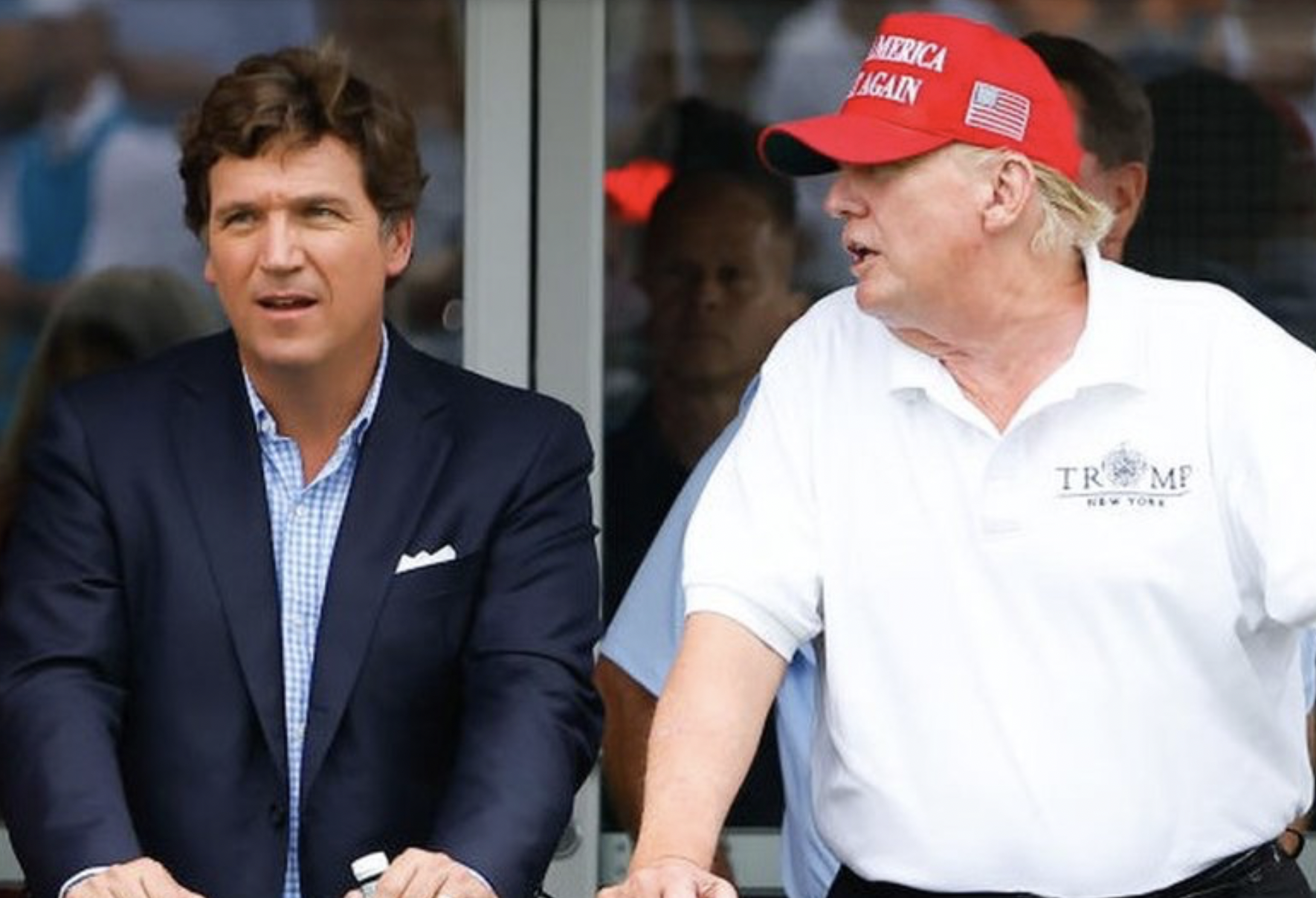
Tucker Carlson may not have said the word out loud, but by the time he finished his blistering Monday monologue, the message was impossible to miss: Donald Trump, in Carlson’s telling, is no longer just a reckless political force. He is something far more sinister.
In one of the most stunning on-air rebukes yet from inside Trump’s own political universe, Carlson openly cast the president as a figure of moral and spiritual corruption, building a case that sounded less like standard political criticism and more like a theological indictment. And for a media ecosystem that has spent nearly a decade defending, rationalizing, or glorifying Trump, the moment landed like a political earthquake.
Carlson’s fury was sparked by a Truth Social post Trump reportedly blasted out at 8 a.m. on Easter Sunday, one that threatened Iran in vulgar terms, invoked destruction of power plants and bridges, and closed with a mocking “Praise be to Allah.” For many critics, it was another example of Trump’s vulgarity and instability. But Carlson framed it as something much darker: a desecration of one of Christianity’s holiest days and a warning sign of where Trump’s leadership is heading.
Before his monologue even aired, Carlson previewed the attack on X with a message that turned heads across the political world: “Desecrating Easter was the first step toward nuclear war. Christians need to understand where Trump is taking us.”
That alone would have been remarkable. But what followed was even more explosive.
For more than 40 minutes, Carlson methodically laid out a case aimed directly at the evangelical Christians who have long formed the core of Trump’s support. He did not rage. He did not ramble. He did something potentially far more dangerous to Trump’s coalition: he offered religious conservatives a moral justification to walk away.
Carlson argued that the central lesson of the Bible is simple but absolute: human beings are not God. Power, unchecked by humility or submission to something higher, becomes destructive. From there, he pointed to Trump’s past behavior and symbolism, including his refusal to place his hand on the Bible during his inauguration, which Carlson said he personally witnessed. Then came the line that seemed to crack open the entire argument: maybe Trump did not place his hand on the Bible because he rejects what is inside it.
That accusation alone was enough to send shockwaves through the MAGA world. But Carlson did not stop there.
He also zeroed in on Trump spiritual adviser Paula White, who during Holy Week compared Trump to Jesus as Franklin Graham looked on. For Carlson, that was not merely embarrassing political theater. It was a line no Christian should tolerate. His response was blunt and devastating: “That is the end.”
That moment became the turning point of the entire monologue. Carlson was no longer asking whether Trump had made a political mistake. He was arguing that Trump’s movement had wandered into something sacrilegious, something morally disqualifying.
Then came the language that pushed the whole attack into even more combustible territory.
Carlson drew a stark contrast between God and Satan, creation and destruction, truth and desecration. He described Trump’s Easter message as “an intentional desecration of beauty and truth,” then boiled it down to one blunt conclusion: evil.
Not misguided. Not impulsive. Not politically toxic. Evil.
And that was the word that changed everything.
Because Carlson never had to explicitly call Trump the Antichrist. He simply built the framework brick by brick, pulling from Christian doctrine, moral language, and apocalyptic undertones until his audience could fill in the blank themselves. It was a stunning bit of rhetorical theater, and perhaps the most dangerous kind of criticism Trump can face: not from the left, not from Democrats, but from someone who knows exactly how to speak to the believers who helped put him back in power.
Of course, Carlson’s motives are already under scrutiny. Critics point out that he has spent years helping fuel Trumpism, only now appearing horrified when the chaos is no longer abstract. Others note that Carlson recently tried to persuade Trump against escalating conflict with Iran and lost that internal fight to more hawkish voices like Mark Levin. In that light, the monologue also looked like a bitter settling of scores.
Still, whatever Carlson’s personal motives, the political effect is real.
He has now handed Trump’s religious base something it has not had in years: permission to question him on moral grounds. That matters because Trump’s support among evangelical conservatives has never been rooted only in policy. It has also been bound up in a larger narrative that cast him as a flawed but chosen vessel. Carlson’s message threatened to blow that narrative apart.
The reaction on the right showed just how deep the rupture may be. Some MAGA-aligned voices praised Carlson for finally speaking uncomfortable truths. Others instantly turned on him, branding him disloyal and demanding he be cast out. The split exposed a fracture that has been growing beneath the surface for years: the divide between those who still see Trump as the movement’s indispensable leader and those beginning to view him as a dangerous cult figure dragging the right toward something ugly and unstable.
For Democrats and Trump critics, the moment was revealing in another way too. It underscored what they have argued all along: that Trump’s threat was never just about bad manners or inflammatory rhetoric. It was about the deeper rot beneath the spectacle, the way his politics distort institutions, language, morality, and even religion itself.
Carlson may have meant to issue a warning to Christians. But what he really did was rip the mask off a movement that has long confused power with virtue.
And in doing so, he may have said the quiet part out loud: Trump is no longer just a political problem. Even his own allies are starting to describe him as something far more dangerous.
Discover more from Next Gen News
Subscribe to get the latest posts sent to your email.
Tucker is right on. I will always be amazed that he got all of the support from the Christian right that he got. They are really easy to con and he is the ultimate conman. Too bad because our nation needed a good leader at the time. Actually, we still do. The Dems may be of little help so long as they keep choosing candidates based on party service and loyalty rather than \”winnability\”. Prof. Schlatter
We might say Carlson, Democrats, and Schlatter have devolved into The AntiChrists… except no Christ, Devil, God, or Satan has ever existed… just more lies from the evil foreign psychotic mass murderous war mongering religion addiction mental illness industry…