

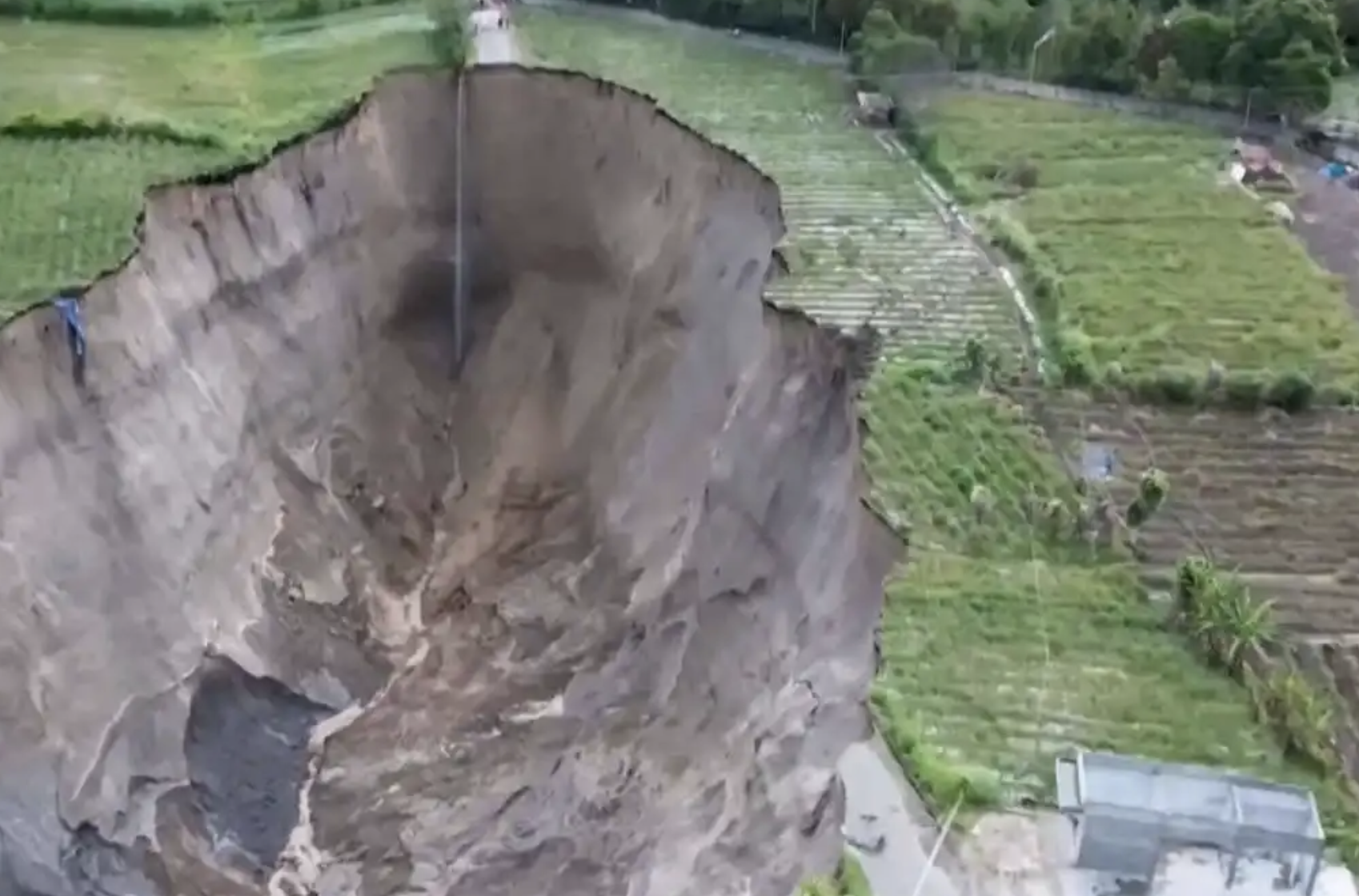
What started as a crack in the earth more than two decades ago has now turned into a gaping disaster zone.
A massive sinkhole in Indonesia’s Central Aceh Regency has ballooned to roughly 7.5 acres wide — about the length of five to six football fields — and plunges nearly 100 meters deep. And officials say it’s growing faster than ever.
The dramatic expansion comes after catastrophic flooding hit the region in late 2025, accelerating ground movement at an alarming pace.
“When the earthquake occurred in 2013, this landslide had already happened,” Central Aceh official Haili Yoga told Reuters. “But after the floods on November 26, 2025, its movement became faster — it moved more in two months than it had in the 13 years before.”
In other words: what took over a decade to expand is now happening in a matter of weeks.
The sinkhole first appeared in the early 2000s, but in recent months it has devoured entire stretches of farmland and a roadway. Coffee crops, chili pepper fields, and other local commodities have vanished into the earth.
And it’s not done yet.
The growing chasm now threatens a nearby electric pylon and more agricultural land — putting dozens of farming families at risk.
Forty-year-old farmer Sumiati says her livelihood has already been destroyed.
“We really hope that the government will provide us with compensation for our losses or find us more land,” she said. “All of ours has been destroyed and we can no longer plant anything. It is uncertain whether we will be able to plant anything next year.”
For many in the region, farming isn’t just a job — it’s survival.
Local farmers say the ground doesn’t just collapse quietly.
“Sometimes when a landslide occurs, it is accompanied by a rumbling sound just like an earthquake,” 53-year-old farmer Suprapto told Reuters.
He says the edge of the sinkhole is creeping closer to homes and fields by the day.
“Yesterday it was about 15 meters from here to the edge. Now it’s only 10 to 11 meters,” he said. “To the ministers and council members, please fix this immediately. Don’t delay.”
The Ketol area, he noted, produces massive amounts of chili peppers and supports between 800 and 1,000 harvest workers. If the land continues to collapse, hundreds of jobs could disappear with it.
According to the Indonesian Geological Agency, the region’s volcanic rock formations are a key factor. When those rocks absorb water — especially after intense flooding — they become unstable, triggering repeated ground movement.
Experts warn that unless water flow in the area is controlled, the sinkhole could continue to expand.
Authorities have already installed safety barriers and are urging residents to stay away from the unstable edges. But for the farmers living beside it, the danger is impossible to ignore.
Officials say they’ve submitted data to the government for further analysis and are awaiting technical guidance on how to help affected communities.
“Hopefully, technical guidelines for handling the affected communities will arrive soon,” Yoga said.
For now, though, the earth keeps moving — and an entire community is left watching the ground beneath them slowly disappear.
Discover more from Next Gen News
Subscribe to get the latest posts sent to your email.