

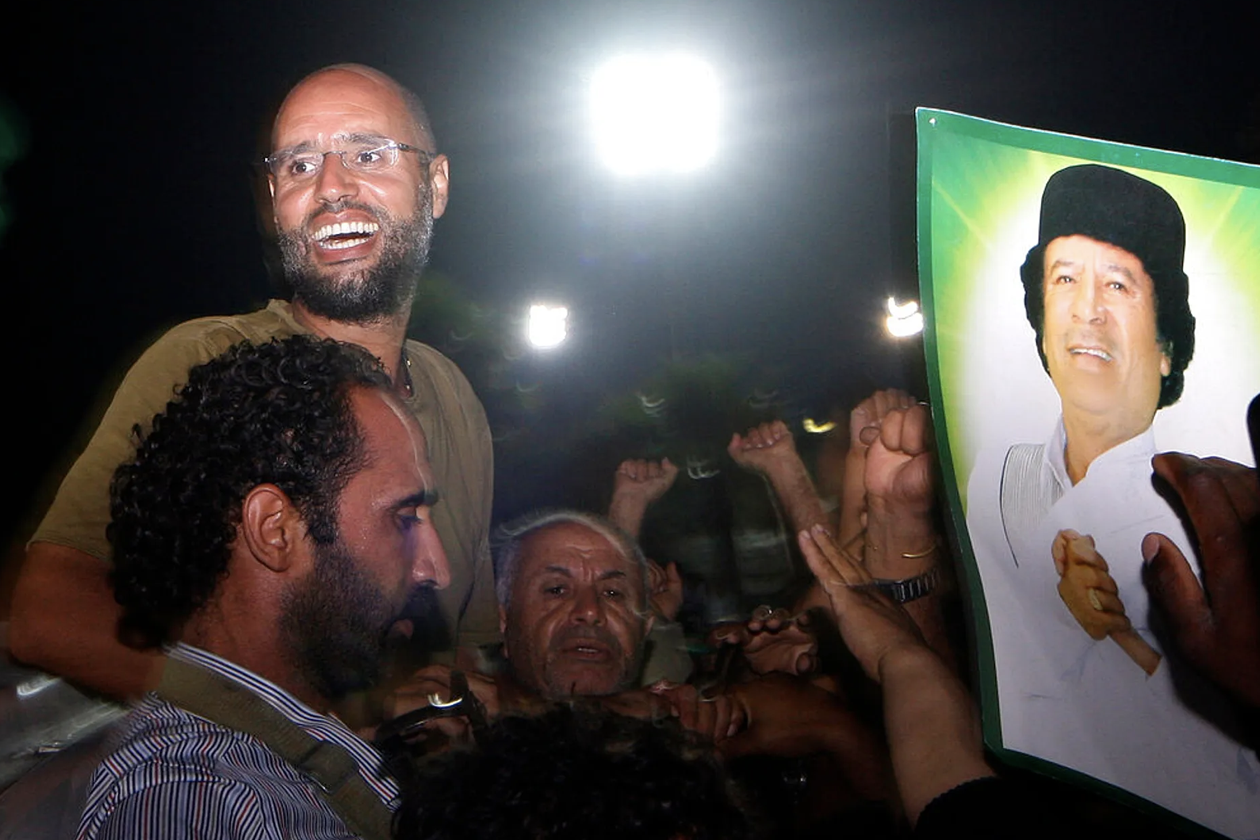
Saif al-Islam Gaddafi, the influential and controversial son of Libya’s former ruler Muammar Gaddafi, was shot and killed Tuesday after masked gunmen forced their way into his home, according to family sources, his attorney, and multiple Libyan media reports.
He was 53.
The killing occurred in the northwestern town of Zintan, where Saif al-Islam had lived for years under the protection of local armed groups. The area has long been a power center for militias that operate largely independent of Libya’s fractured central authorities.
A Targeted Assassination
In a statement released by his political team, four masked men were said to have stormed the residence and carried out what they described as a “cowardly and treacherous assassination.”
“Armed attackers entered the home and killed him in cold blood,” the statement said.
His lawyer, Khaled al-Zaidi, confirmed the death in a brief social media post, offering no additional details. Libyan officials have not publicly identified suspects or announced arrests.
Local reports indicated the attackers disabled the home’s surveillance cameras before opening fire. One account suggested Saif al-Islam attempted to confront the assailants as they moved to conceal evidence of the attack.
A Once-Powerful Heir
Born in Tripoli in 1972, Saif al-Islam was widely viewed as the most politically significant of Muammar Gaddafi’s sons and, for years, the expected heir to his father’s four-decade rule.
Western-educated and fluent in English, he studied at the London School of Economics, where he pursued a doctorate. During the final years of his father’s regime, he cultivated an image as a reformer, engaging with foreign governments and advocating limited political and economic changes.
Critics, however, argued that he remained deeply complicit in the authoritarian system his father led.
Detention and International Charges
Following the 2011 uprising that ended the Gaddafi regime, Saif al-Islam was captured by anti-Gaddafi fighters in November of that year. He was held for nearly six years by a militia in Zintan.
In 2015, a Libyan court sentenced him to death in absentia for his alleged role in violently suppressing protests during the revolution.
He was also sought by the International Criminal Court on charges of crimes against humanity linked to the 2011 crackdown on demonstrators.
He was released in 2017 after receiving amnesty from one of Libya’s rival governments and continued to reside in Zintan, largely out of public view.
A Failed Political Return
Saif al-Islam reemerged on the political stage in November 2021 when he announced plans to run for president, a move that ignited fierce backlash from anti-Gaddafi factions across Libya.
Many opponents viewed his candidacy as an attempt to rehabilitate the former regime.
Libya’s High National Elections Committee disqualified him from the race, and the election itself was later canceled amid disputes between rival governments and armed groups.
A Nation Still Divided
More than a decade after the overthrow of the Gaddafi regime, Libya remains politically fragmented, with power divided among competing administrations, militias, and foreign-backed factions.
Repeated efforts to hold national elections and achieve reconciliation have stalled.
Saif al-Islam Gaddafi’s killing highlights the enduring instability and unresolved tensions that continue to shape Libya’s post-revolutionary landscape, underscoring how deeply the country remains divided over its past and its future.
Discover more from Next Gen News
Subscribe to get the latest posts sent to your email.
Just everyday activity for Libyans and Democrats…
Lived by the sword. Died by the sword.